
Home EV Charger Repair: When We Can Fix Your Price Before We Fix Your Charger
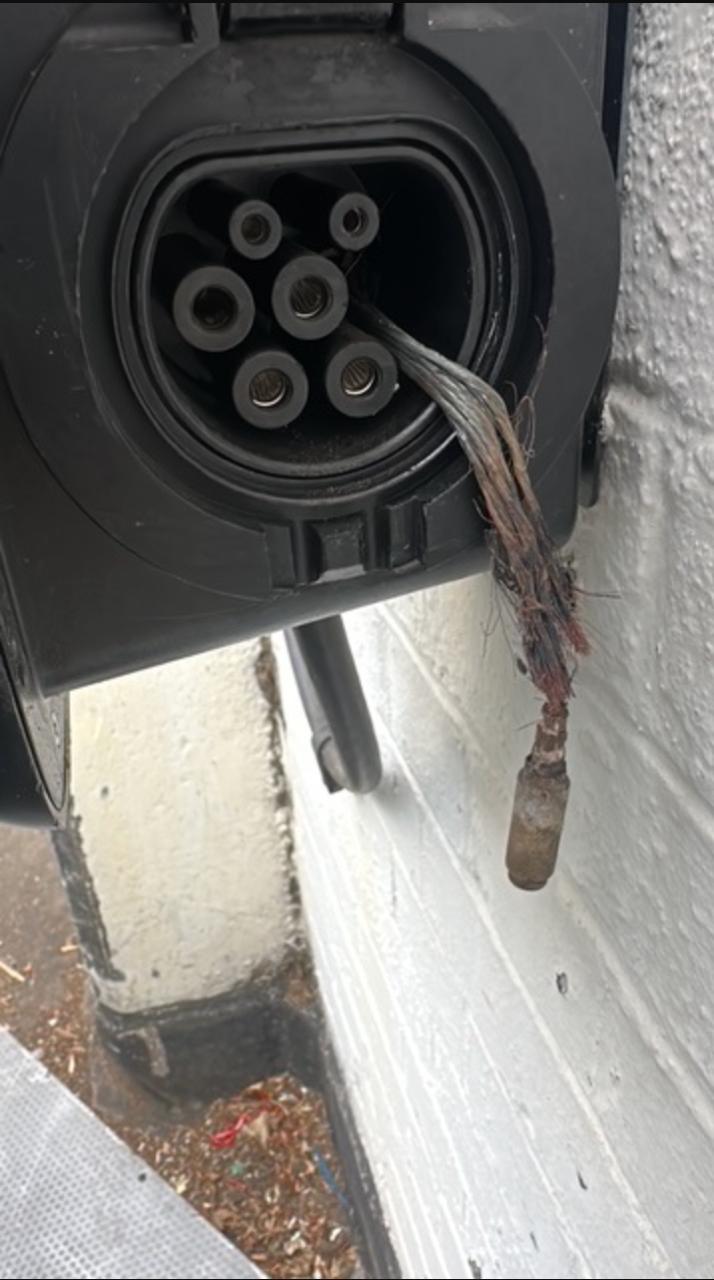
The photograph at the top of this page is a real home charge point we were called out to. The owner did what thousands of drivers do without thinking: picked up a charging cable that had been lying in the rain, pushed it into the socket, and started a charge.
\n\nWhat you can see is what was left of the socket afterwards. The contacts arced, the heat melted the plastic around them, and the conductors inside the plug were burnt back to bare, discoloured copper. Nobody was hurt. But that unit was drawing 7 kW through a joint that was slowly destroying itself, and it had been doing so for a while before anyone noticed.
\n\nWhat actually happens when water gets into the socket
\n\nA Type 2 connection is designed to be weatherproof when it is mated and locked. It is not designed to have water sitting on the pins at the moment you push it home. When it does, three things happen in quick succession:
\n\n- \n
- The water bridges the contacts. A small leakage current starts flowing between pins that should be isolated from each other. \n
- Arcing begins. As the connector seats and unseats by a fraction of a millimetre - every time the cable is knocked, or the car rocks on its suspension - the current breaks and re-strikes. Each tiny arc is thousands of degrees at the contact point. \n
- The plastic carbonises. Once the surface of the insulator is scorched, carbon becomes a conductor. The fault now feeds itself and gets worse with every charging session, even after everything has dried out. \n
That last point is the one drivers get wrong most often. "It dried out and it still works" is not a reason to keep using it. Carbon tracking does not dry out. It spreads.
\n\n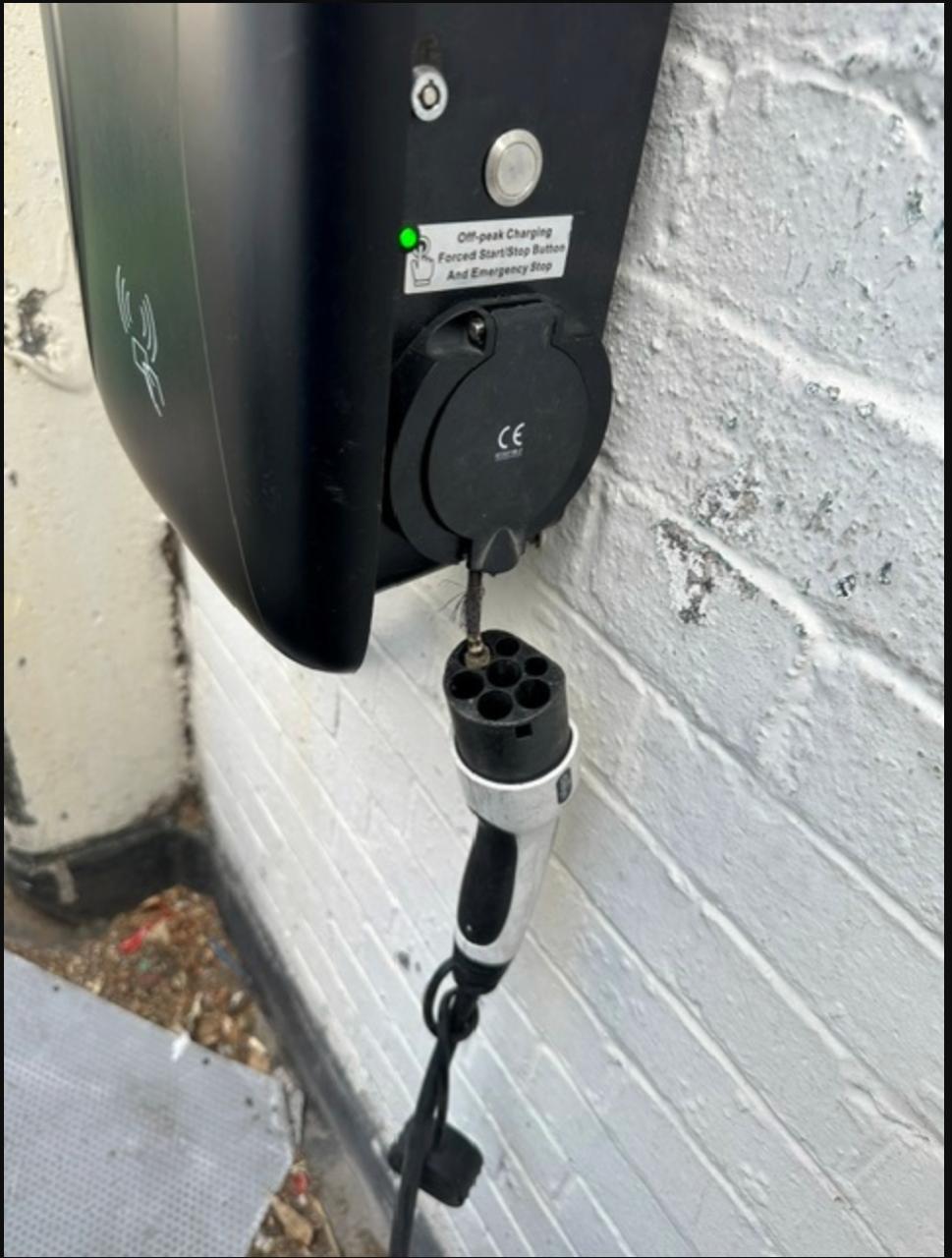
Here is the same unit from further back. From a metre away it looks like a perfectly ordinary wall box with the green light on. The damage is entirely inside the socket. This is exactly why we tell people that a charger which still appears to work is not the same as a charger which is safe.
\n\nStop using it. Genuinely.
\n\nIf you can see any of the following, switch the charger off at its isolator or consumer unit and stop charging from it:
\n\n- \n
- Brown, black or bubbled plastic anywhere inside the socket or on the plug face \n
- A smell of hot plastic or fish after a charge \n
- The plug or cable being hot to the touch near the connector - warm is normal, hot is not \n
- The charger tripping its RCD or your consumer unit repeatedly \n
- Visible green or white corrosion on the pins \n
Repeatedly resetting a breaker to force a damaged charger to keep working is the single most dangerous thing you can do with one. The breaker is not being temperamental. It is doing its job.
\n\nDiagnosis and repair are two different purchases
\n\nThis is where the EV charging trade tends to be vague, so we will be blunt about it.
\n\nA diagnostic visit is an engineer coming to your property to find out what is wrong. It covers travel, testing and a written answer. Across the UK this is typically charged at £90 to £150, and reputable firms will not quote you a repair price before they have done it - because until somebody has opened the unit, "my charger is not working" could mean a £15 seal or a £400 control board.
\n\nA fixed-price repair is a different promise entirely: we come out, and we fix it, for one number agreed in advance. No hourly creep, no parts bill arriving afterwards, no second visit charge if the first part was not the culprit.
\n\nWe can offer that second option on many of the home units we see, including the one in these photographs. Where we can, the all-in figure is around £400 including VAT and parts - and if the job turns out to need more work than expected, that is our problem, not yours.
\n\nWhat the fixed price covers
\n\n- \n
- The engineer's visit and travel \n
- Full diagnostic testing of the unit and its supply \n
- Labour to carry out the repair \n
- The replacement parts the repair needs - socket assemblies, contactors, RCD modules, control boards, seals, glands \n
- Electrical testing and sign-off afterwards \n
When we cannot fix the price in advance
\n\nWe will not pretend it applies to everything. We quote a fixed all-in price depending on the station, and we tell you which you are getting before an engineer is booked. It is usually not available where:
\n\n- \n
- The unit is a model we cannot source parts for at all, so the honest answer is replacement rather than repair \n
- The fault is in your property's wiring rather than in the charger - a damaged buried supply cable is groundworks, not a charger repair \n
- The charger is still under manufacturer warranty, in which case you should claim it and we will tell you so \n
- The damage is severe enough that a new unit costs less than the repair, which is common on older 3.6 kW boxes \n
That last case is worth doing the arithmetic on. If a repair approaches the price of a new charger, replacing it gets you a current-generation smart unit, a fresh warranty, and - where the household qualifies, the £500 EV chargepoint grant against the cost. Check you actually qualify first. Since April 2022 the home grant no longer covers owner-occupiers of houses with a driveway - it is limited to people who rent, own and live in a flat, or have only on-street parking and are fitting a cross-pavement gully, and the schemes run until 31 March 2027. Most people with an existing charger on a house got theirs under the old scheme before the cut-off and cannot claim again. We would rather tell you that than take the repair money.
\n\nWe repair chargers we did not sell
\n\nMost of the home units we are called to were installed by somebody else, and a good number are brands we do not manufacture. That is fine. We build and install our own home charging stations, which means our engineers work on charger internals every day rather than treating a wall box as a sealed appliance to be swapped out.
\n\nIt also means we are not trying to talk you into a new unit. A melted socket is a socket. If it can be repaired properly and certified, we will repair it.
\n\nHow to not need us
\n\nThe fault in these photographs was entirely preventable, and the prevention costs nothing:
\n\n- \n
- Never plug in a wet connector. If the plug face has water on it, dry it before it goes anywhere near the socket. \n
- Do not leave the cable on the ground. Hang it on the holster. A connector lying in a puddle or on wet gravel is the start of this whole story. \n
- Close the socket cover when nothing is plugged in. It is there for a reason. \n
- Look inside the socket every few months. Torch, ten seconds. You are looking for discolouration, not perfection. \n
- Do not force a stiff connector. Stiffness usually means a worn latch or a swollen seal, and forcing it damages the contacts. \n
Getting it looked at
\n\nIf your charger has stopped working, is tripping, or simply looks wrong inside the socket, send us the details and a photograph if you can - a clear picture of the socket face tells us a great deal before anyone travels, and it is how we decide whether we can commit to a fixed price for your unit.
\n\nYou can read more about what we cover on our home EV charging repair page, or see the full charge point repair service for commercial and public units. If you would like the market context on what repairs cost generally, we have written that up in our EV charger repair cost guide for 2026.
\n\n