
Delta Error 00400D: The Manual Says the Air Inlet Sensor. It Was Not the Sensor
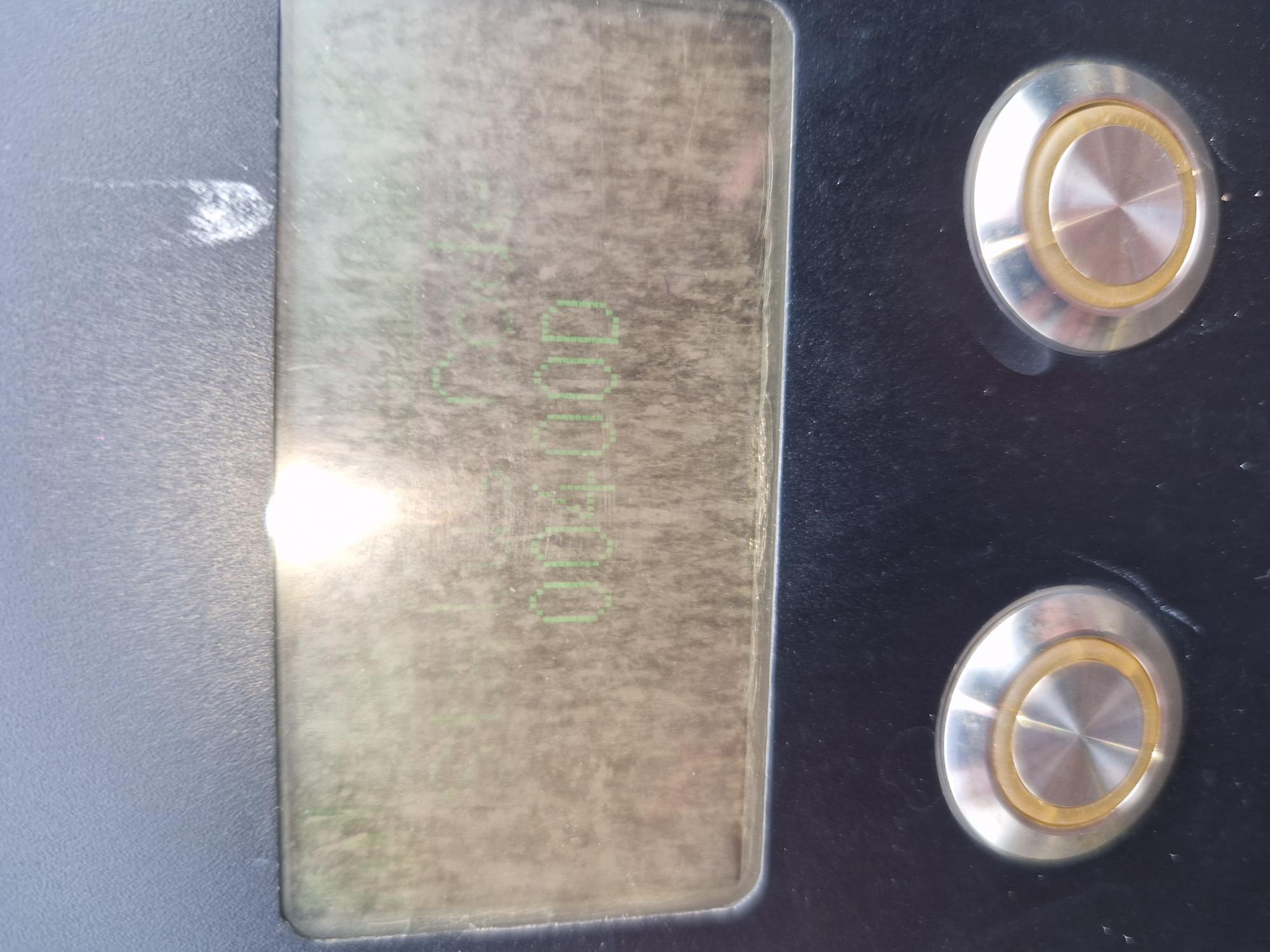
A Delta 25 kW DC wall unit would not start. It runs a self-test before it will begin a session, the self-test failed, and the screen showed 00400D.
Delta publishes what that code means. The answer is one line long, it is accurate in its own terms, and following it would have had us replacing the wrong part.
Where Delta publishes its EV charger error codes
They are published, and most owners never find them, because the document is not called anything like “error codes”. The DC Wallbox Installation and Operation Manual carries a table headed System Code, with two columns — Alarm Code and Description — and 109 entries. It covers the EVDE25 family, which is this unit. The row reads, verbatim:
00400D — The temperature sensor of air inlet is broken
Two things about that table are worth knowing before you go looking for it.
The codes are six characters and hexadecimal. Delta never says so anywhere in the manual, but the sequence gives it away: within one family the codes run 004009, 00400A, 00400B, 00400C, 00400D, 00400E, 00400F, then 004010. If you are reading a code off a weathered screen and you drop a character, you will search for something that does not exist. There is no five-character code in Delta's scheme.
And the table is the whole of it. There is no test procedure for any of the 109 codes, no part number, no sequence to work through, and — this one matters — no indication of which codes stop the unit starting and which are only warnings. The manual's Troubleshooting section is seven consumer questions: a blank screen, the RFID card, a wobbly mounting. For anything else its instruction is to contact the service number.
What we checked, and what each check said
Taking the code at face value, the fault is a temperature sensor in the air intake. So:
- The main cooling fan was running. Visibly, audibly, with the door open.
- The supply to the cooling system tested good. Voltage present and correct where it should be.
- The fan itself tested good. Drew what it should draw and ran when it should run.
Three tests, three passes, and a station that still would not start. This is the point at which the job either stops or gets interesting, because everything the documentation names is working.
What it actually was
There was a second, much smaller fan in the cooling supply, and its wire had been pulled off.
The air-inlet temperature sensor shares that connector. Take the fan wire off and the sensor circuit goes with it.
So the code was telling the truth. The controller had lost the air-inlet temperature reading, and “the temperature sensor of air inlet is broken” is a fair summary of what it could see from the inside. It just names the sensor — and the sensor was perfect. You can test that sensor all afternoon and it will pass every time, because the sensor was never the fault. Its connection was, and what broke the connection was a fan.
The sensor itself is about the size of a match head. Nothing in the manual describes it, nothing describes the second fan, and nothing connects either to code 00400D. Finding it meant looking very closely at a part nobody had mentioned and working out what it was doing there.
The general rule, worth more than any table of error codes
A fault code names the check that failed, not the part that broke.
“The temperature sensor of air inlet is broken” is the controller's summary of one thing: the air-inlet reading did not arrive. A dead sensor produces that. So does a good sensor on a broken connection — and a connection can be broken by something with nothing to do with temperature at all, several components away, for reasons the software has no way of seeing.
Shared connectors are where this bites hardest. When two unrelated parts sit on one plug, a fault in either is reported as a fault in whichever one the software happens to be watching. The code is not wrong. It is downstream of the actual event, and it names the passenger rather than the driver.
The manufacturer writes the description from inside the software, where the check lives. The engineer reads it from outside, where the parts are. The two do not map one to one, and no manufacturer's table is ever going to say “or, alternatively, somebody may have pulled a wire off a small fan you did not know was in there”.
This is why a code is a starting point and never a diagnosis. It tells you which subsystem the controller lost confidence in. Which component actually failed inside that subsystem is a separate question, and on an eight-year-old unit it is often not the component the code names.
Two things worth doing before you call anyone
Write the code down before you switch it off. Delta says this itself in the maintenance section, and it is the single most useful thing an on-site person can do: “Before switching off the main breaker to cut off power, please record the error code on the display screen.” Once the unit is powered down the code is gone, and an engineer arrives with nothing to go on.
Photograph it rather than reading it out. The screen on this unit had clouded badly enough that a character was easy to lose, and a code with a character missing sends everybody in the wrong direction before anyone has left the yard.
Look at the ventilation. On a unit complaining about anything temperature-related, blocked louvres are a genuine contributor and they cost nothing to check.
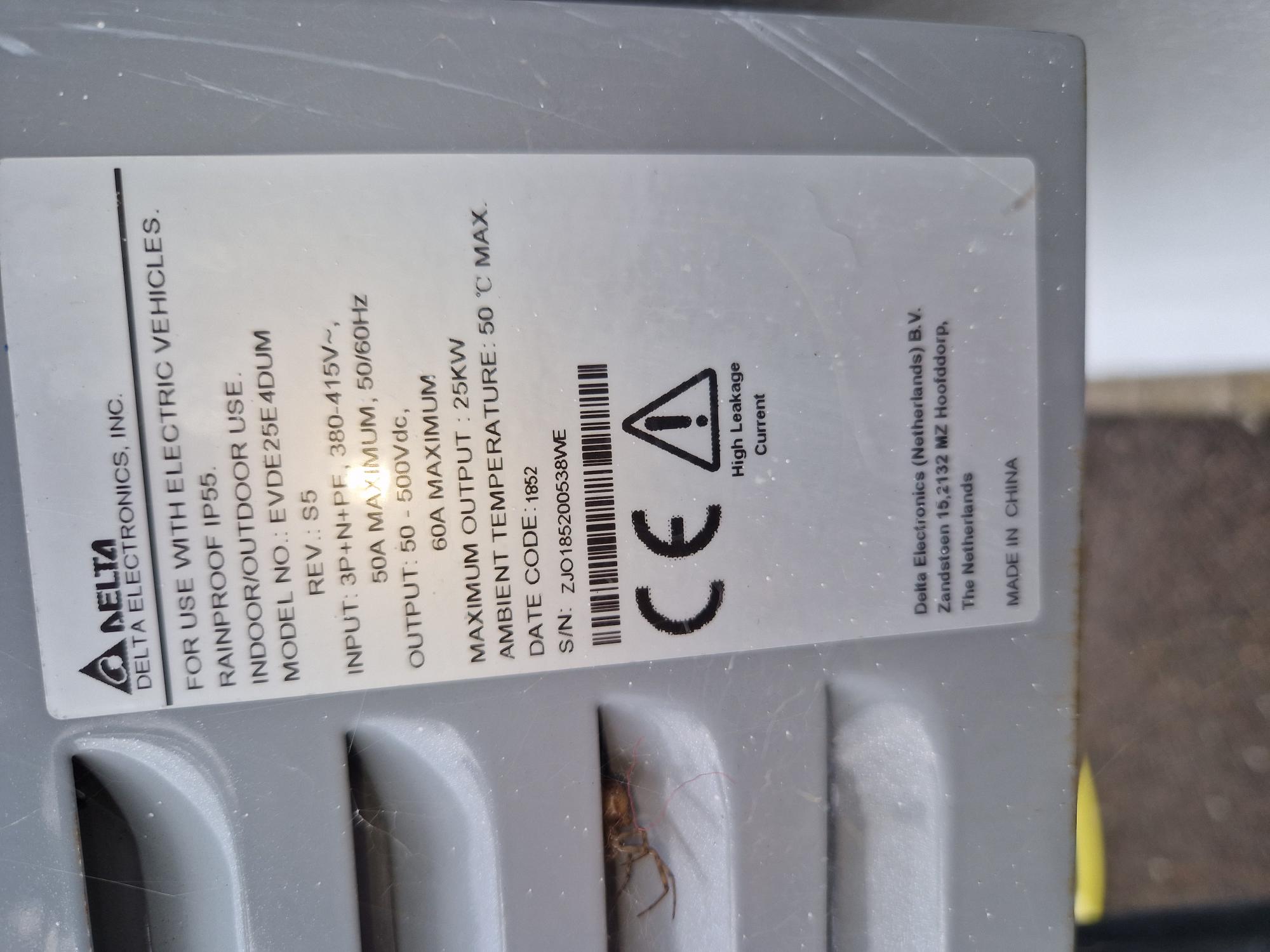
That photograph was taken to record the rating plate. The cobwebs and debris packed into the intake louvres were incidental — and on a station reporting an air-inlet fault, they are the sort of thing a scheduled visit would have cleared long before it became anybody's emergency. That is most of what EV charger maintenance is: the cheap checks, done on a date, instead of the expensive ones done in a hurry.
Where this leaves owners of these units
The unit in question is an EVDE25E4DUM, and its rating plate carries a date code of 1852 — week 52 of 2018. There are a lot of DC wall units of that generation on British sites, bought when a 25 kW wallbox was a serious piece of kit, and they are now at the age where things start going.
At 25 kW they sit below the 50 kW threshold where the public charge point reliability duty bites, so for most owners this is not a legal problem. It is a commercial one, and usually a worse one: a busy unit that is out of service is losing money every day it stands there, and the busier the site the more it costs.
We repair charge points of any make. Because we design and manufacture our own charge point electronics, we work at component level and hold sockets, connectors, contactors and control components in stock, so a fault found on the visit can often be corrected on the same visit rather than becoming an order and a second appointment.
On DC units our answer is repair. Re-equipping an enclosure with our own control electronics is something we do on AC units, where the power switching sits on a separate contactor rather than on the control board. A DC cabinet is a different machine — the power stage is a set of modules, not a contactor — and we will say so rather than sell you something that does not fit.
If your unit is showing a code
Send us a photograph of the screen, a photograph of the rating plate, and one line on what the unit does — whether it will not start at all, drops out mid-session, or starts but never delivers current. That is usually enough for us to tell you whether this is a visit, a part, or something the site can clear itself.
Send us a message about your charge point
Related: 10 checks before you call an engineer · charge point repair service · public EV charger repair · commercial EV charger repair