
Your EV Charger Trips the Breaker. There Are Two Very Different Reasons, and They Need Opposite Responses
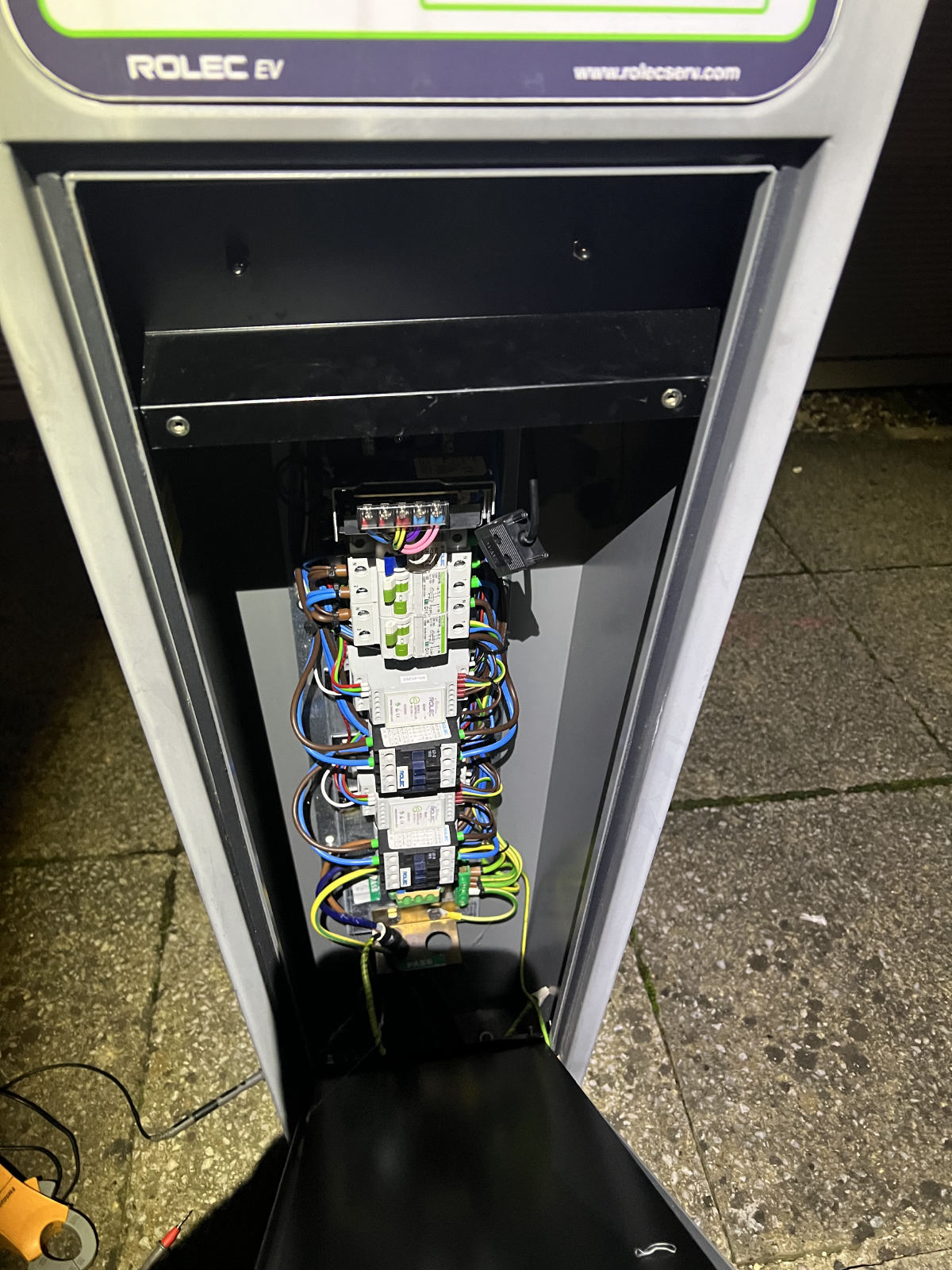
Something in the consumer unit has gone off and the car has not charged. From where you are standing, every trip looks the same: a switch is down, and putting it back up feels like the whole of the problem.
It is not. There are two quite different reasons a charging circuit disconnects, they are detected by different mechanisms, and the correct response to one is the opposite of the correct response to the other.
Trip one: earth leakage. Something is wrong. Stop.
An RCD or the RCD half of an RCBO compares the current going out with the current coming back. If they do not match, the difference is going somewhere it should not — through damp insulation, through a damaged cable, through a failing component in the car, or through a person. A domestic device operates at around 30 mA, well below the level that stops a heart, and it does it in a fraction of a second.
That is not a nuisance. It is the device doing the single job it was fitted for.
Reset it once. If it goes again, stop using the charger. Every reset re-energises whatever it detected. We have written this up in full, with what actually causes it and what an engineer should test, in why your EV charger keeps tripping the RCD.
Trip two: overload. Nothing is broken. The circuit is being asked for more than it is rated for
The other half of an RCBO, and a plain MCB, does something completely different: it watches how much current is flowing and disconnects when that stays above its rating for long enough.
Nothing is faulty when this happens. There is no leakage, no damaged cable, nobody in danger. The circuit is simply being asked to carry more than somebody designed it to carry, and it is refusing — which is also exactly the job it was fitted for.
The tell is in the timing. An earth-leakage trip is usually immediate, often at the moment the connector goes in or within seconds of the session starting. An overload trip takes a while — minutes, sometimes most of an hour — because the device has a deliberate time delay so that ordinary brief surges do not nuisance-trip it. If your charger runs happily for forty minutes and then everything goes off, that is a different animal from one that dies the moment you plug in.
What amp breaker does an EV charger need?
A single-phase 7.4 kW charge point draws around 32 amps, and it draws it continuously for hours, which is unusual behaviour for a domestic circuit. Most things in a house take a large current briefly — a kettle, a shower, a motor starting. A car takes a steady one all night.
So the numbers that matter are not just the charger's. They are the cable's cross-section, the rating of every protective device between the meter and the charge point, and what the rest of the property is doing at the same time. If any one of those is smaller than the charger is set to draw, the smallest number wins — eventually.
Which is why “what size breaker for an EV charger” has no single answer, and why anybody who gives you one without seeing your installation is guessing. It is also the answer to a question people ask a lot: 32 A and 40 A are not two options for the same thing. One is what the charge point pulls; the other is the rating of a device protecting the circuit that feeds it. They are different numbers describing different objects, and the second has to be chosen for the installation by whoever designs it, not copied off a forum.
What happened to us, which is the reason this article exists
We were commissioning a charge point on an older installation — one of those that went in early, before anybody knew how charging was going to develop, and built to the expectations of the time.
We do the current setting properly. A display is connected temporarily and the charging current is set against what is physically there: the cross-section of the buried supply cable and the rating of the contactor doing the switching. We checked both. Both were comfortably adequate for 7.5 kW. So that is what we set it to.
What we did not do was find every protective device on the way back to the meter, because the owner could not show us where his other breaker was. We knew there was one. We could not put our hands on it. We set the current anyway.
It ran perfectly on the first day.
On the second day it tripped. When the device was finally located, it turned out to be rated at 25 amps — comfortably below the 32 the charger was now asking for. Nobody knew who had fitted it, when, or why that rating had been chosen. It had simply been sitting there for years, limiting a circuit nobody had had a reason to load until a car was plugged into it.
We went back through the supply properly. The property had the capacity to deliver 7.5 kW to the car, so with the owner's agreement the device was replaced with a 40 A one and the installation has been fine since.
What we take from it, and what you should
The cable was right. The contactor was right. The setting was right for both of them. And it still tripped, because on an older installation the binding constraint is often somewhere nobody has recorded, chosen by somebody who is no longer around, for a reason that was never written down.
Two practical consequences.
If you own the property: before an engineer sets your charging current, be able to point at every protective device between the meter and the charge point. Not “there's one somewhere in the garage” — open the cupboard and show it. Ten minutes of looking beforehand is worth considerably more than a second visit, and it is the one part of the job the owner can do better than the engineer, because it is your building.
And if it trips on day two rather than day one, do not assume the new equipment is faulty. A charge point that ran fine for a day and then stopped is behaving exactly as an overload should behave: the first session was shorter, or the house was doing less, or it simply had not run long enough for the device to reach its threshold.
Which one have you got?
Before anybody attends, this is genuinely useful to know:
- What actually tripped — the device for the charger alone, or one covering half the house?
- How long had it been charging when it went? Seconds, or the best part of an hour?
- Does it trip with nothing plugged in? If yes, that is the charger or its supply, not the car and not the load.
- Is it weather-related? Damp faults follow the forecast; overloads follow the clock.
- Did anything change recently — a smart meter fit, solar, a battery, building work, or a new car with a bigger onboard charger than the last one?
That last one catches people out on its own. The charge point did not change; the car did.
What we will not do
We will not solve a tripping problem by fitting a bigger device and walking away. Increasing a rating is only legitimate once the cable, the supply and the rest of the installation have been shown to carry it — which is what we did on the job above, and in the right order. Anyone who offers to make the tripping stop without establishing that first is proposing to remove protection rather than fix anything.
And if the honest answer is that your supply cannot support 7.4 kW, we will say so. A charge point set to a lower current still charges a car overnight perfectly well, and it is a far better outcome than one that keeps dropping out.
If yours is tripping
Tell us which device went, how long it had been charging, and whether it does it with nothing plugged in. We repair and commission charge points of any make, we manufacture our own control electronics, and we hold protective devices, contactors, sockets and connectors in stock.
Send us a message about your charger
Related: why your charger keeps tripping the RCD · 10 checks before you call an engineer · home EV charger repair · charge point repair service