
What the Light on Your EV Charger Means
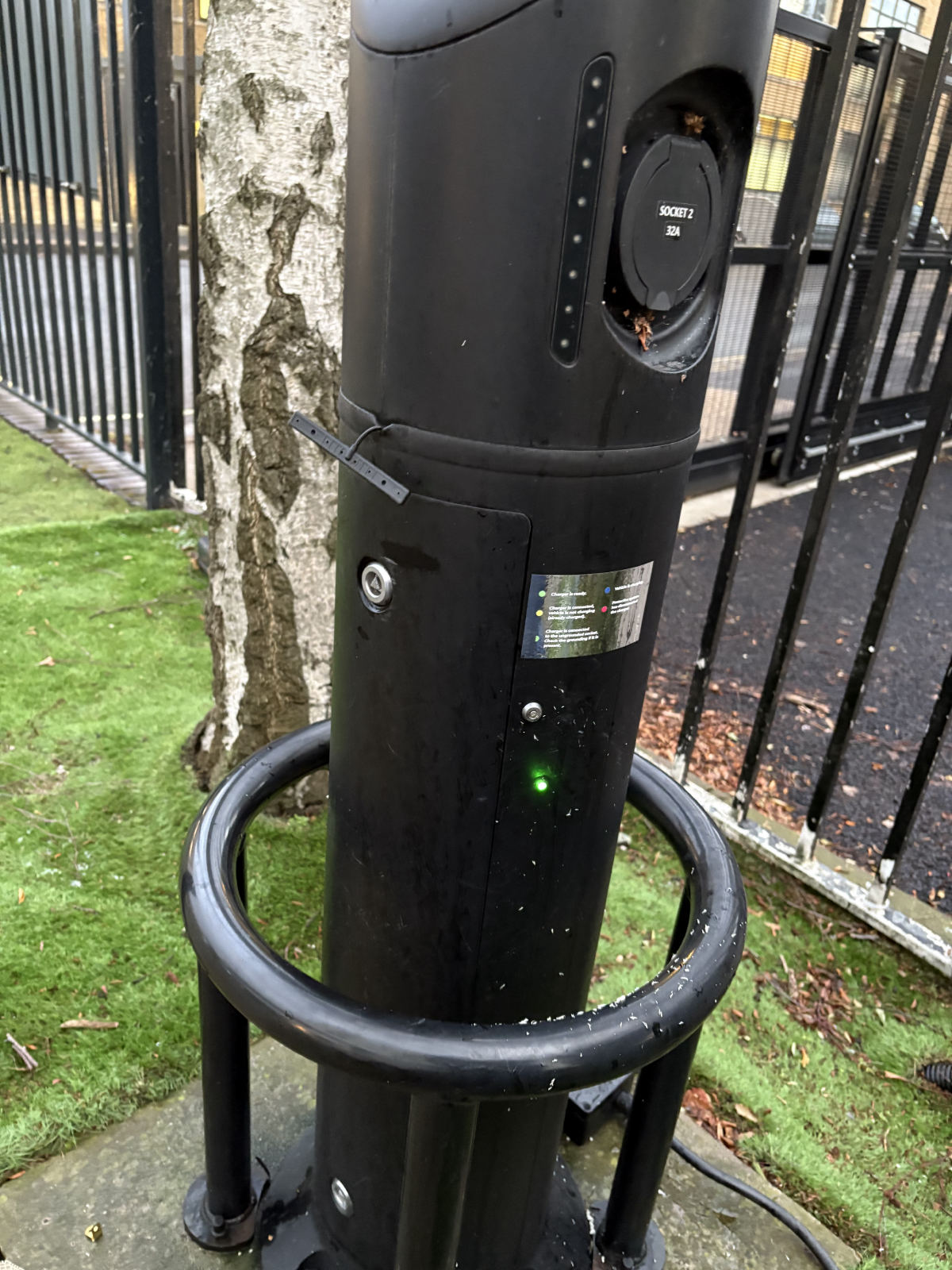
A charge point tells you almost everything it has to say with one light. It is the first thing you look at and usually the only thing you have to go on, so it is worth knowing what it is actually claiming.
Below is what the colours mean on the units we build and on the ones we re-equip. Other manufacturers use their own conventions and some of them differ, so there is a note at the end on how to find out what yours means — but the underlying logic is the same across nearly all of them, and that part is worth understanding first.
The logic behind the colours
Whatever the make, a status light is answering three questions in order:
- Is it alive and available?
- Is it delivering current right now?
- Is something wrong, and is it the sort of wrong you can do anything about?
That last split is the one that matters. A colour is a category, not a diagnosis. It tells you which of those three states the charger believes it is in. It does not tell you which component is at fault, and no light on any manufacturer's unit ever will.
What each colour means on our units
A steady green light — ready
The charge point has power, has passed its checks and is waiting. Nothing to do. If you have plugged in and it is still green, look at the car: a schedule in the vehicle or in a tariff app will hold the charge until its window opens, and that is by far the most common reason a healthy charger appears to be doing nothing.
A blue light — charging
Current is flowing to the vehicle. This is the one you want to see when you walk away.
Yellow — look at it, but it is not an emergency
Yellow means attention rather than alarm, and two quite different situations produce it.
The car is connected and has stopped taking charge — normally because it is full. Nothing is wrong. This is the light you should expect to find in the morning.
Or the supply the charger is connected to has no earth. This one deserves a paragraph of its own.
A red light — the protection has operated. This one needs an engineer
If you came here to find out what the red light on your EV charger means, this is it: the protective system has disconnected the charge point deliberately. It is not a glitch and it is not something to clear by switching things off and on until the colour changes.
We do not ask the owner to interpret it, because there is nothing useful an owner can do with a fault classification. Red means one thing: stop using it and get someone to look at it.
The earth indication, and why it is on the list at all
Most charge points will not tell you that the supply they are plugged into has no earth. Ours will, and it is the single most useful thing a status light can say.
An earth connection is what gives the protective devices something to detect against. Without it, a fault that should trip a device in a fraction of a second may not be detected at all, and the first thing that completes the circuit could be a person. A charge point on an unearthed supply can look completely normal and charge a car perfectly well for years.
So if you see that indication, it is not a fault in the charger. It is the charger telling you something about the installation it is connected to, and it is worth acting on rather than living with.
What a colour cannot tell you
A light is a summary written by software, and software reports the check that failed rather than the part that broke. We have written up a case where that distinction cost real time: a DC unit reported a fault its own manufacturer documents as a broken air-inlet temperature sensor. The sensor was perfect. The connector it shared with a small fan had been pulled off.
That is not a criticism of status lights. It is the reason they are deliberately simple on our units: four states an owner can act on, and a fifth that says the answer is not on the outside of the box.
Why there is no screen
Our controllers can drive a display, and we used to fit one. We stopped after our first complaint about it, which was that the screen could not be read — and the customer asked for a bigger screen.
This is the charge point that complaint was made about.
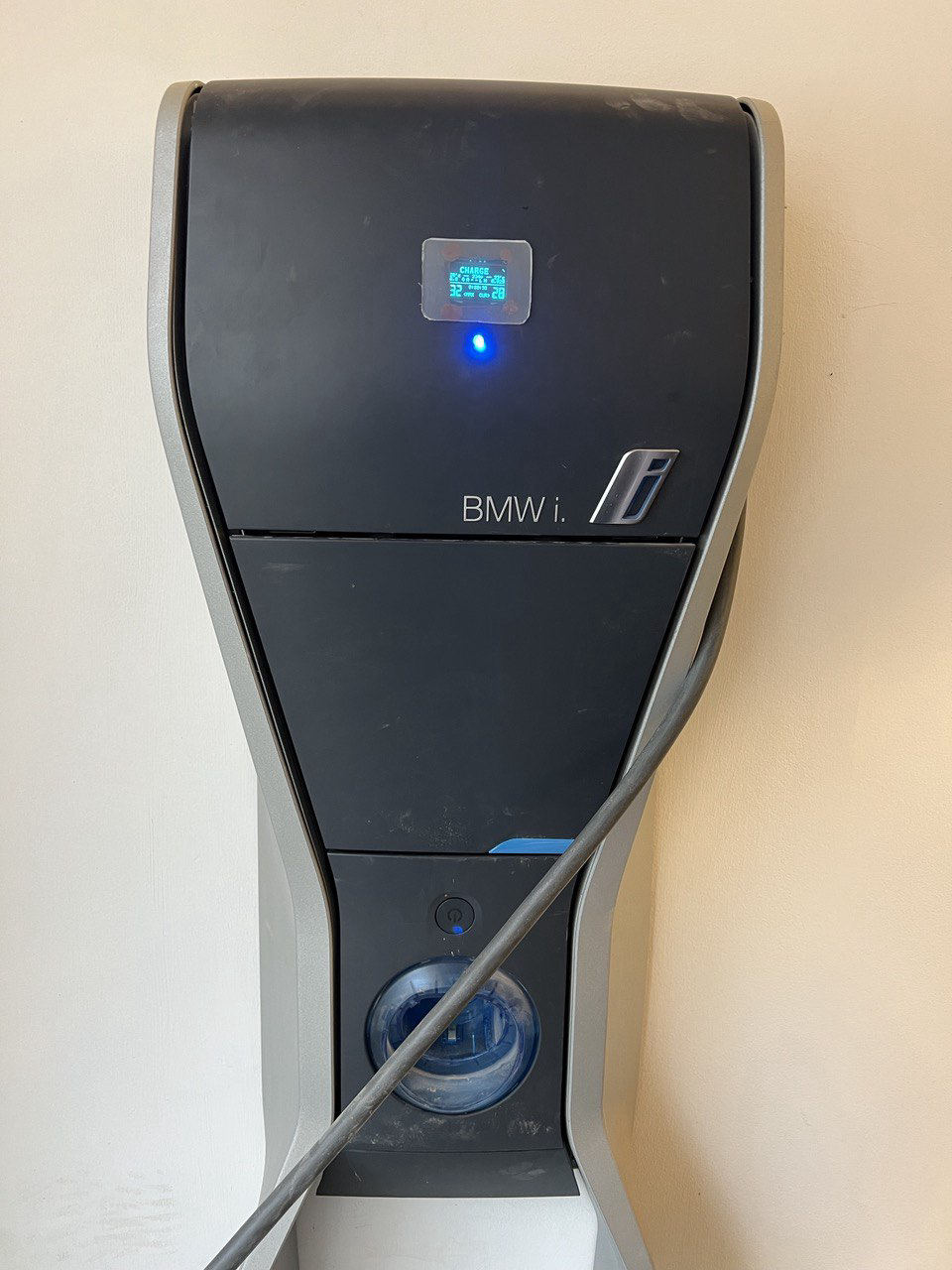
Look at the size of the display against the size of the unit. It is a window about a centimetre across on an enclosure half a metre tall, and that photograph was taken deliberately, close up, in good light, indoors. Now imagine reading it from the driver’s seat on a wet evening.
The customer was right. Worth noting whose charge point it is, too: this is not a budget box, it is a manufacturer-branded unit from a premium car maker. Small unreadable displays on charge points are not a cost-cutting problem.
The complaint was right and the proposed fix was not. A bigger screen is a bigger consumable: it fogs, it bleaches, it gets broken, and it still cannot be read from a car in the rain. We have since seen where that road ends on other manufacturers' equipment, on a unit whose display had clouded so badly that a character was lost out of the fault code.
So the display became an engineer's tool rather than an owner's. We connect one temporarily during commissioning, to set the charging current to what the installation can actually carry, and then take it away. What stays on the wall is a light and a printed legend telling you what each colour means — readable from the car, in weather, with no firmware behind it that can crash or lie.
Green and blue are the same news. Which is which depends on the make
This trips people up when they change charger or use somebody else's, and almost nobody explains it.
There is no international standard for the colour of a status light. There are two conventions, and they are the reverse of each other:
- Green means ready, blue means charging. This is the European convention and it is what we use.
- Blue means ready, green means charging. You will meet this on units built in Japan and programmed in the United States.
Neither is wrong. Both colours signal a normal, healthy charge point in both conventions — the disagreement is only about which of the two normal states each one marks.
So the rule that survives any make is simpler than the table: green or blue, the charger is fine. If you want to know which state you are in, watch it once through a session you know is running, and you will have learned that unit for good.
What does not vary is the other end of the range. Amber or yellow means look at it. Red means stop.
If your charger is a different make
Two things are worth doing:
- Photograph the light rather than describing it. “Flashing greenish” down a message costs an engineer a wasted visit. A photograph and a note of how many flashes and how often does not.
- Note what it was doing at the time — plugged in or not, mid-session or from cold, and whether anything else in the property had just been switched on.
And on any make, red is red: stop, and have it looked at. Our ten checks before you call an engineer covers what is safe to do yourself first, and why a charger that keeps tripping the protection should never be repeatedly reset.
Tell us what it is doing
Send us the make and model, a photograph of the light and one line on what the charger does. We repair charge points of any make, we build our own control electronics, and we hold sockets, connectors, contactors and control components in stock, so a fault found on the visit can often be corrected on the same visit.
Send us a message about your charger
Related: home EV charger repair · charge point repair service · EV charger maintenance