
This Damage Is Contagious. Your Cable Catches It From Public Chargers and Brings It Home
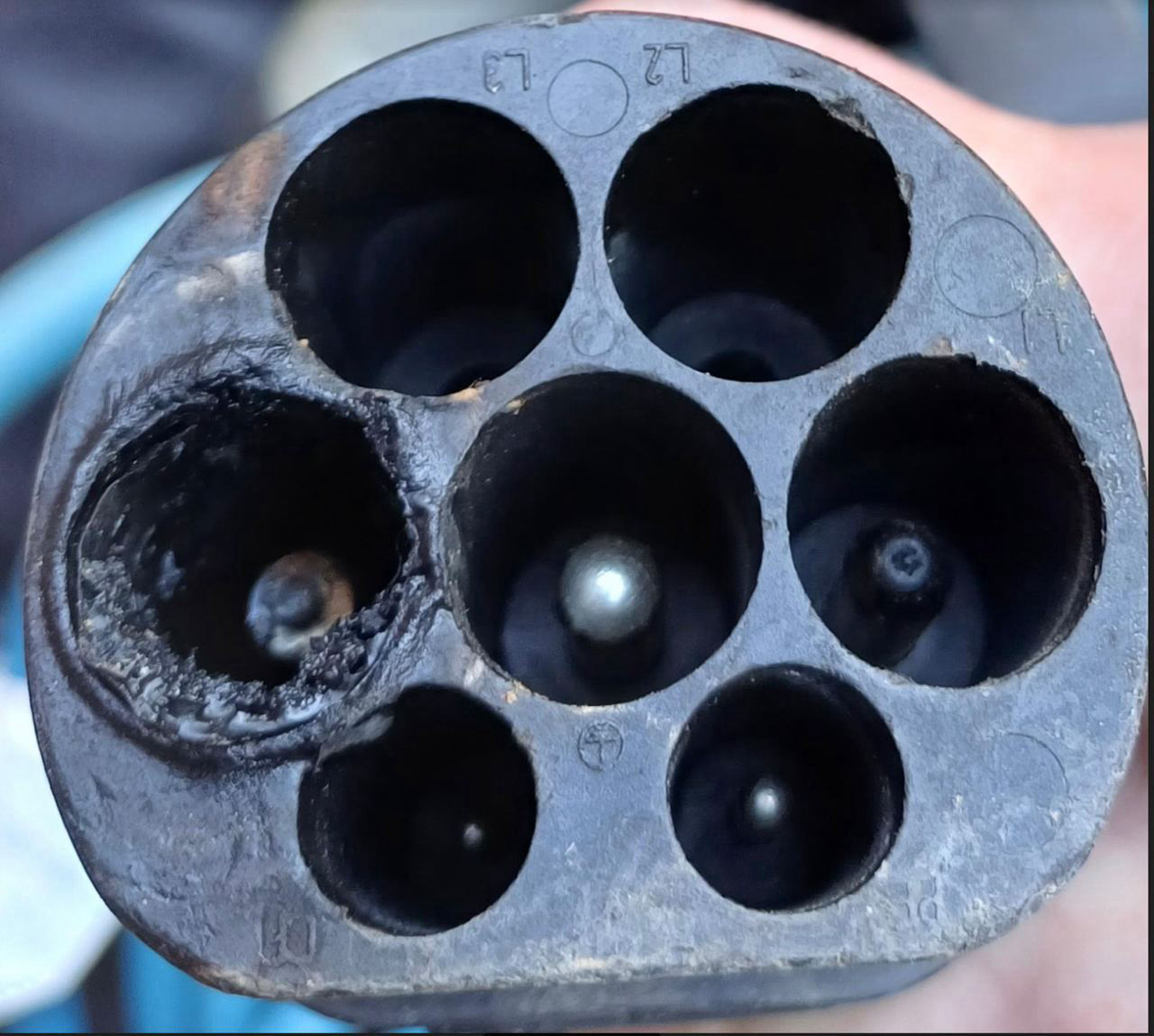
Look at the face of this connector. Six of the seven contacts are clean, grey, exactly as they left the factory.

The seventh has been running hot for a long time. The plastic around it is melted, blistered and charred, the shape of the recess has gone, and the pin itself has darkened.
The owner did not know. It still charged the car.
What that one contact is telling you
A connection either has a large area of metal pressing on metal, or it does not. When it does not — because a contact has worn, or a spring has weakened, or corrosion has formed a film on the surface — the current has to squeeze through a smaller area. Resistance goes up, and resistance carrying 32 amps for four hours a night makes heat exactly where the contact is worst.
Heat then makes the problem worse. It anneals the spring, it oxidises the surface further, it deforms the plastic that holds everything in position. Once it has started, it accelerates.
That is why one contact looks like this and its neighbours look new. Nothing is wrong with the cable as a whole. One interface went slightly bad and then destroyed itself.
The part nobody tells you: it spreads
Here is the thing that changes how you should think about this, and we have not seen it written anywhere.
The heat is not generated in the plug or in the socket. It is generated between them. A bad connection has two halves, and both of them cook.
So follow what actually happens over a few weeks:
- A public charge point has a socket that has started to go — worn, slightly corroded, a contact that no longer grips.
- You plug your own cable in. The bad interface damages your plug, because your plug is one half of it.
- You drive home with a connector that is now slightly worse than it was that morning.
- You plug it into your own charge point. Now your plug is the bad half, and it starts working on your socket.
You did not do anything wrong. You brought it home.
And it works in both directions: a damaged tethered cable on a public unit is being made worse by every car that plugs into it, and a damaged plug is quietly damaging every socket its owner visits.
The two rules
Neither costs anything and both take seconds.
Before you plug into a public charge point, look at the socket. Ten seconds with the torch on your phone. If you see browning, melted or bubbled plastic, deposits on the pins, or one contact that looks different from the others — do not use it. Use the next bay, and report it if there is a way to.
Check your own connector regularly. Both ends of a portable cable, the plug on a tethered one. You are looking for exactly the same signs. If you find any of them, the cable is finished.
Do not carry on with it
This is the part where people go wrong, and it is understandable, because a damaged connector still works. It charges the car, the light goes the right colour, and it gives no warning at all until it does.
We have photographs of what the far end of this looks like: a home charge point destroyed from the inside, with its status light still showing green from a metre away. Nobody set out to run it into that state. It just kept working, so it kept getting used.
A cable in this condition is not a thing to keep an eye on. It is a thing to stop using.
Why the socket sometimes gets blamed for the cable
When a charge point starts tripping, or a session drops out, or the socket gets hot, the natural assumption is that the charge point has developed a fault. Often it has. But an owner who has been plugging a damaged connector into it for six months has been feeding it heat every night, and the charge point is the victim rather than the cause.
This is worth knowing before you pay for a repair. If the cable is not replaced at the same time, the new socket goes the same way.
It also cuts the other way. If your cable has burnt at one end only, the question worth asking is which socket did that — because if it is one you use regularly, that socket is also part-way through the same process.
What to look for, precisely
On the plug face and inside the socket:
- Discolouration — brown or bronze staining around one contact when the others are clean. This is the earliest sign and the one worth catching.
- Melted, bubbled or reshaped plastic around a contact.
- Green or white deposits on the metal — corrosion, often from moisture.
- A pin that sits differently from its neighbours, or one that looks pitted rather than smooth.
- Heat you can feel. Warm after a long charge is normal. Hot is not, and hot at one point rather than generally is a contact problem.
- A smell of hot plastic after a session. That is not something to note and carry on with.
The single most useful habit is comparison. You are not trying to judge whether a contact looks bad in the abstract — you are checking whether one of them looks different from the other six. That is much easier, and it is what the photograph above shows.
Keeping it from starting
Most of what causes this is mechanical and preventable:
- Push the connector fully home. A partly seated plug has a smaller contact area, which is where the whole process begins.
- Never leave the cable under tension. A connector being pulled sideways is not sitting square in its socket, and it is being levered rather than held. We have attended a charge point where the front panel was pulled out of the enclosure by drivers stretching for the last couple of centimetres.
- Keep it off the ground. A connector lying in a puddle fills with water, which then goes into the socket. See what water does inside a charge point.
- Dry the plug face before it goes in, if it has been out in the wet.
- Do not force a stiff connector. Stiffness means a worn latch or a swollen seal, and forcing it damages contacts.
If yours looks like the photograph
Stop using it, and look at every socket you have been plugging it into.
Send us a photograph of the connector face and of the socket, and the make and model of your charge point. We will tell you whether this is a cable, a socket, or both — and if you have been running it for a while, it is very often both.
We repair charge points of any make. Because we manufacture our own charge point electronics we work at component level and hold sockets, connectors and control components in stock, so a fault found on the visit can often be corrected on the same visit rather than becoming a second appointment.
Send us a message about your charger
Related: 10 checks before you call an engineer · why your charger keeps tripping the RCD · home EV charger repair · EV charger maintenance