
Charging in the Rain Is Fine. Covering Your Charger Is Not
Two questions get asked constantly and they have opposite answers, which is why so many people end up making their charge point worse while trying to look after it.
Is it safe to charge in the rain? Yes. Entirely. The connector and the socket are designed to be handled and used outdoors in weather, and people do it several million times a day.
Should you cover your charger to keep the rain off? No — and if you already have, it is worth reading the rest of this.
Is an EV charger waterproof?
Weatherproof rather than waterproof, and that distinction is the whole of this article. A charge point is a sealed electrical enclosure with an ingress protection rating, and those ratings are on the rating plate. The Delta DC unit we wrote about in another article carries IP55 on its label, along with the words RAINPROOF and INDOOR/OUTDOOR USE. Wall boxes and pedestals carry their own equivalents. They are tested for it.
But keeping water out is only half of what an enclosure does, and it is the half everybody thinks about. The other half is letting whatever does get in find its way back out again: drainage paths, breathing, airflow, gravity, and covers that are shaped so water runs off rather than sits.
Some water always gets in. Not through a failure — through the air. Warm damp air enters during the day, the temperature drops overnight, and the moisture in it condenses on the coldest surfaces inside. That happens in every outdoor enclosure ever made, and the design assumes it. What keeps it harmless is that the same enclosure lets it dry out again the following day.
What a cover does instead
Wrap a bag round it, build a box over it, print a shroud for it, and you have not stopped the first half. Damp air still gets in — around the cable, through the same gaps as before, and off the cable itself when it is put away wet.
What you have stopped is the second half. Nothing dries. The daily cycle that used to clear the moisture now just adds to it, and the enclosure that was designed to breathe becomes a container.
So the socket ends up wetter than it would have been with nothing over it at all — permanently damp instead of intermittently damp, which is a completely different thing for a set of electrical contacts.
What we found under one

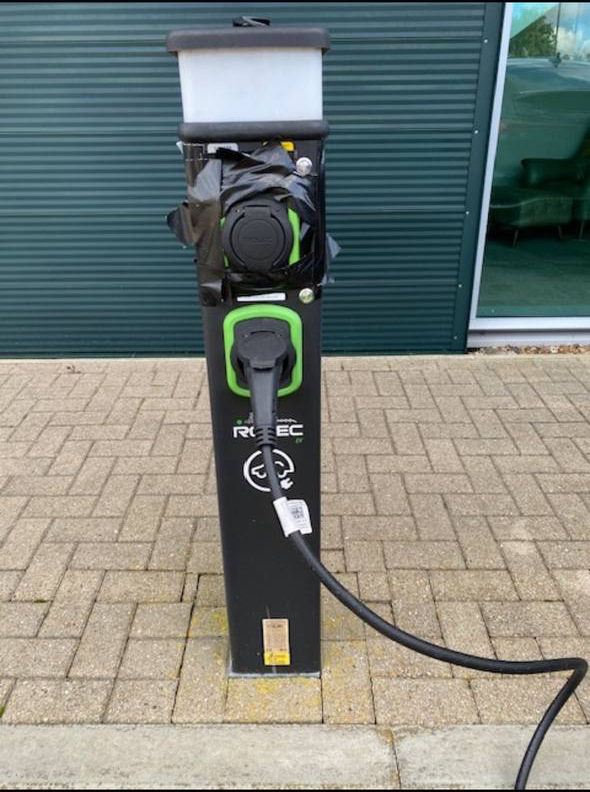
We were called to this one. Somebody had taped black plastic sheeting around the upper socket of a Rolec pedestal to keep the weather off it. It is not vandalism and it is not laziness — it is somebody trying to look after their equipment with the materials to hand, and it is a completely reasonable thing to think.
Underneath, the contacts were all in poor condition from moisture. Not one of them. All of them.
Wet contacts do two things, and both get worse the longer they go on. They provide a leakage path to earth, which is what starts the tripping that owners describe as happening “for no reason” — we have written up why a charger keeps tripping the RCD and why moisture is the first thing we look for. And they corrode, which raises resistance, and resistance under a 32 amp load for hours at a time makes heat. That is the road that ends with the socket in our fixed-price repair article, which was destroyed from the inside while its status light was still showing green.
What we did
As usual, the pedestal stayed. It was structurally fine, it was in the right place, and the buried supply and civils underneath it were the expensive part of that installation.
We replaced the sockets, because the contacts were too far gone to be worth cleaning, and we fitted our own control electronics in place of the original controller. The charge point went back into service in the same spot, on the same supply, with documentation and a warranty on the electronics we fitted and the work we did.
No plastic on it.
What to do if your EV charger got wet, and what to do instead of covering it
If you want to look after an outdoor charge point, these are the things that genuinely help, and they are all free:
- Close the socket cover when nothing is plugged in. It is the actual weather protection and it is designed to shed water. It only works when it is shut.
- Hang the cable on its holster. A connector lying on wet ground fills with water and then gets pushed into the socket, which is how a great deal of moisture gets inside a charge point that is otherwise perfectly sealed.
- Dry the plug face before it goes in if it has been sitting out. A cloth, two seconds.
- Look inside with a torch a couple of times a year. You are looking for discolouration, green or white deposits on the pins, or anything that looks bubbled or scorched. Thirty seconds, twice a year, catches nearly all of this before it costs anything.
- Keep the ventilation clear on a unit that has vents. On the Delta we attended, the intake louvres were packed with cobwebs and debris.
And if the unit really is taking water — if there is standing water inside it, if the socket cover is missing or broken, if the seal has perished, if the enclosure is cracked — that is a repair, not a covering job. A cover over a leaking enclosure hides the fault and accelerates it. Get the thing that is letting water in fixed, and then it does not need covering.
The one case where a cover is fine
A purpose-built canopy or shelter that stands away from the unit — a roof over the parking bay, a post-mounted hood with clear air all round it — is a different proposition entirely. It keeps direct rain off you while you are plugging in, and it does not seal anything, so the enclosure carries on breathing exactly as designed.
The problem is never shelter. It is contact: anything wrapped against, taped to, or sealed around the unit itself.
If yours has been covered
Take the cover off, open the socket cover, and look inside with a torch. If you see any discolouration or deposits on the pins, stop using it and have it looked at — that is not something to clean up and carry on with, because the damage is at the contact faces where the current actually flows.
Send us a photograph of the socket face and the make and model, and we will tell you whether it is a clean-up, a socket, or a bigger job. We repair charge points of any make, manufacture our own control electronics, and hold sockets, connectors and control components in stock, so a fault found on the visit can often be corrected on the same visit.
Send us a message about your charger
Related: 10 checks before you call an engineer · the two kinds of trip and what each means · home EV charger repair · EV charger maintenance