
Your Charging Cable Won't Quite Reach. What People Do About It Is What Breaks the Charger
You have parked as close as the bay allows and the connector is still a couple of centimetres short of the car. So you pull. It reaches, it clicks, the car charges, and nothing appears to have happened.
Something did happen. It just will not present itself for another year, and when it does it will look like an unrelated fault.
This is what a cable that is too short actually costs, on three charge points we have attended, and what to do about it instead.
The cable is the longest lever on the machine
A charge point is a box bolted to a wall or set into the ground, and attached to it is a metre or more of heavy cable that a person can get both hands on. Nothing else about the installation gives anybody that kind of purchase.
So when force is applied, the cable is not what gives way. Whatever the cable is attached to is what gives way — the entry gland, the strain relief, the panel it passes through, or something quietly routed nearby that nobody thought about.
And the force is not a single event. It is one driver, once, then another, then another, several times a day on a busy site, for years. Each one on its own is harmless.
Three charge points, three brands, one cause
The front panel that came out

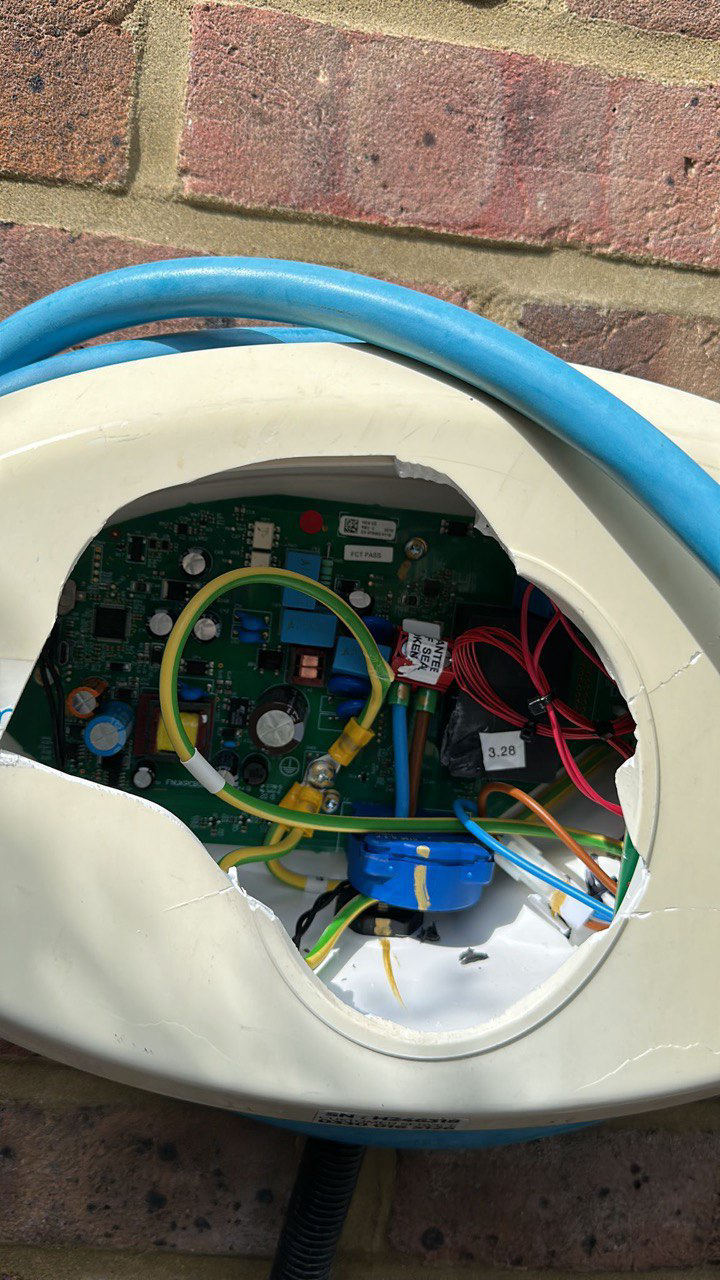
This is a Chargemaster Homecharge — the white oval box that was the standard bp pulse home unit for years. It was not hit by a car. It was pulled apart by people stretching sideways for the last two centimetres they needed, over and over, until the panel let go.
Once the enclosure was open the weather finished it. By the time we saw it, every contact was in poor condition from moisture. Water inside a charge point does not need long.
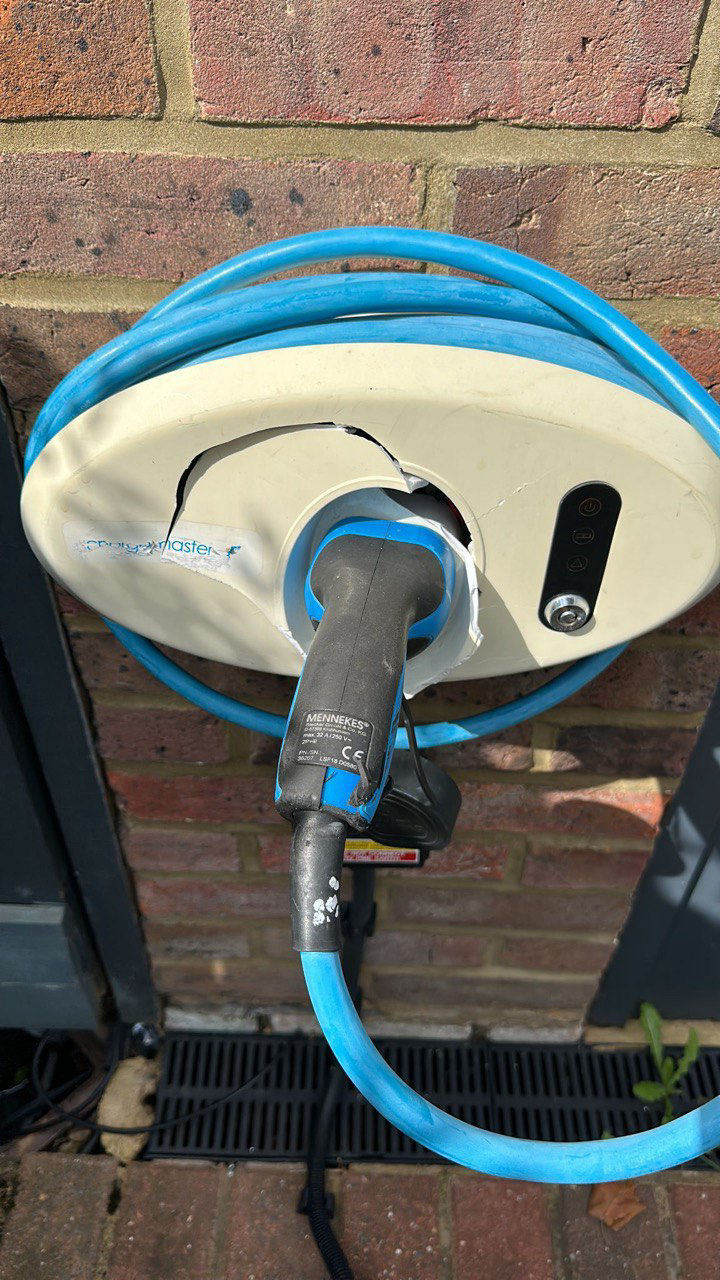
Back in service: our control electronics, the panel repaired with an identical piece of plastic bolted from behind around the perimeter, and converted to a tethered cable so there is no socket left to fill with water.
The one that reported a cooling fault
A 25 kW DC unit that would not start, showing a temperature-sensor fault. The sensor was perfect. The main fan was running. The supply tested good.
The actual cause was a small fan in the cooling supply whose wire had been pulled off — and the sensor shared that connector. Something near the cable entry had been worked loose over months, and the fault it produced pointed somewhere else entirely. The full diagnosis is here.
That is the pattern worth understanding: pulling damage almost never announces itself as pulling damage. It arrives disguised as a sensor, a controller, a leak.
The pedestal with the panel forced out
Same story on a third brand, a bollard on a commercial site: the panel around the socket forced out of the enclosure, wiring exposed to the weather, in a yard anyone can walk into.
And once, for balance, it genuinely was a vehicle — a delivery van turning in a tight space. A post on a turning circle has a short life. But that is the exception. The rule is people reaching.
So use an extension lead?
This is what most people look for next, and it is the wrong answer for a reason worth understanding rather than just being told.
Every extension adds two more contact interfaces to a circuit carrying 32 amps for hours at a time. We have photographed what happens when one contact interface starts to degrade: the heat is generated between the two halves, both halves cook, and the damage then travels to whatever they are next mated with.
Adding connections to that circuit adds places for it to start. More length also means more resistance and more heat along the whole run, and the connectors were designed to mate with a vehicle inlet and a charge point socket, not with each other. Most manufacturers say plainly in their instructions not to use extensions, and that is the reason.
An extension also does nothing about the mechanical problem. The pulling continues; it just happens further along.
How long can an EV charging cable be?
If your charge point has a socket rather than a fixed cable, this is the answer almost everybody is looking for and almost nobody is given.
Buy a longer cable. Five metres is what comes in the boot of most cars because it is what fits in the boot of most cars. Type 2 leads are made in 7.5 and 10 metre lengths, from the same manufacturers, to the same standard, and they are an ordinary purchase.
That is a completely different thing from an extension. One cable with a connector at each end is exactly what the system was designed around — no added joints, no added contact interfaces, and the conductor size is chosen for the length by whoever made it. It is the difference between using a longer tool and lashing two tools together.
Charging cable length is limited by practicality rather than by safety. Ten metres is about where that runs out: a 32 amp lead at that length is heavy, stiff in cold weather and awkward to coil. If ten metres still will not reach, the charge point is in the wrong place and no cable is going to fix that.
A longer lead costs rather less than a repair, and considerably less than a replacement charge point.
What actually fixes it
For a tethered unit, or where a longer lead is not enough:
- Move the charge point. If every driver stretches, it is in the wrong place. On a wall this is usually a short cable run and an afternoon.
- Fit a longer tethered cable. On a tethered unit the cable is replaceable, and where the enclosure allows it this removes the reaching problem permanently. On the Chargemaster above we went the other way for the same reason — converted it to tethered, which also removed the socket that had been filling with water.
- Change the bay, not the equipment. A repainted line, a moved wheel stop or a reversed parking direction can be all it takes.
- Hang the cable properly. A holster keeps the connector off the ground, which is a separate problem with the same cure.
The rule, for anyone who owns a charge point
The cable should never be under tension.
Not tight, not stretched, not held at an angle by the car it is plugged into. If it is, the installation is wrong — and it is wrong in a way that is currently being paid for in instalments by the enclosure.
For a site owner this is worth watching for directly. If you see drivers stretching, you do not have a driver problem. You have a siting problem, and it will arrive as a repair bill. The unit is not being abused; it is being used in a position that requires abuse.
And if it has already happened
A broken panel or a pulled-out entry is not the end of the unit. On the charge point in the photographs above, everything except the electronics and the front panel stayed — the enclosure, the mounting, the supply cable, the groundworks.
We design and manufacture our own charge point electronics, so where the enclosure and supply are sound we repair the damage, re-equip the unit and hand it back with documentation and a warranty on what we have fitted. Where the enclosure is beyond repair or the supply is undersized, we will say so instead.
Send us a photograph of the unit and of the damage, and one line on where the cars park relative to it. That last detail tells us whether you need a repair or a repair and a rethink.
Send us a message about your charge point
Related: why connector damage spreads · 10 checks before you call an engineer · EV charger maintenance · commercial EV charger repair