
Your BMW Charger Is Not a BMW. Lift the Lid and It Is Somebody Else's Charge Point
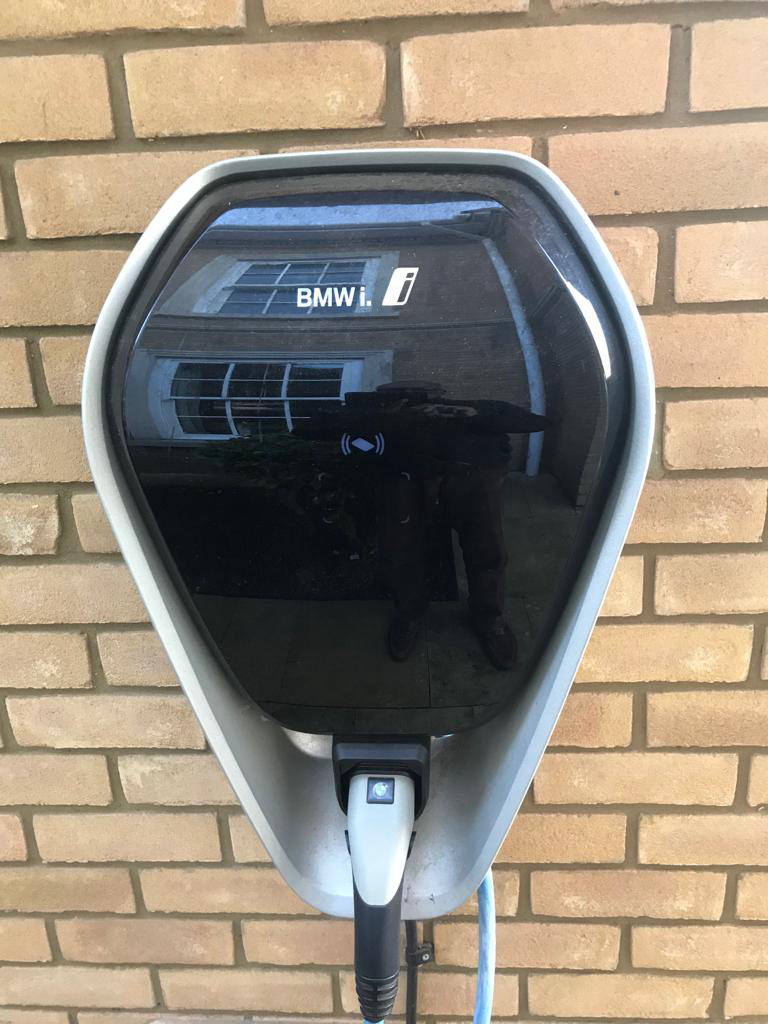
A customer called us about a wallbox on the side of his house. He held his card against the reader the way he always had, and nothing happened. No charge, no error he could act on, just a unit that had stopped doing the one thing he needed.
He had assumed, reasonably, that this was a job for the car manufacturer whose badge was on the front. That assumption is the reason a lot of perfectly good charge points are standing idle in Britain.
Car makers do not make charge points
They commission them, and they put their own shell on the outside.
BMW's wallboxes are built by KEBA, an Austrian automation company. KEBA won BMW's tender in December 2014 and built a dedicated production line for them — it says so on KEBA's own website. The unit behind the BMW glass is substantially KEBA's own KeContact product.
Mercedes has been reported as sourcing its Wallbox from EVBox of Amsterdam. Other marques use other suppliers. The pattern is the same across the industry, and it is not a secret or a scandal — it is ordinary manufacturing. Car companies build cars.
What it means for an owner is the useful part. Under the badged lid is a normal charge point from a normal charge point manufacturer, with normal components inside it, and it can be worked on like any other.
Why this matters more as the units get older
These wallboxes were sold alongside cars from the middle of the last decade, which makes a lot of them eight to ten years old now.
A car maker is not a charge point support organisation. It supported an accessory that came with a car it sold a decade ago, through a dealer network built around vehicles, and there is a limit to how long that lasts — not through anybody behaving badly, just through time. Meanwhile the box on the wall is not a car accessory at all. It is a piece of electrical equipment on a dedicated circuit, and it long outlives the commercial arrangement that put it there.
So the owner is left believing that only one company in the world can touch it, when in fact the thing on the wall was never made by that company.
We have lifted the covers on plenty of these — BMW, Mercedes, others — and inside you find a charge point from a manufacturer you can name. Once we show an owner what is actually in there, almost all of them go ahead the same day.
What we did not do: find out which part had failed
This is where our answer differs from what a repairer would normally tell you, and it is worth being straight about why.
The card reader not responding could be the reader itself, the connection to it, the controller behind it, or the record of which cards are allowed. On a unit of this age, chasing that down means hours of fault-finding, followed by a hunt for a part that may not be manufactured any more, fitted next to electronics that are the same age as the part that just failed.
The alternative is to replace the control layer entirely. About an hour's work, and the charge point goes back with a year's warranty on what we have fitted and the work we have done.
Set those side by side and the diagnosis becomes academic. Whichever component had failed, the answer was the same, and the answer that comes with a warranty costs less than the one that comes with a parts search.
That is not a shortcut. It is the arithmetic being honest about itself.
Where we do the opposite
On DC rapid units we repair rather than re-equip, and there we go all the way down to the component — because the control layer is not something we replace, so identifying the exact fault is the entire job.
There is a worked example of that here: a 25 kW unit reporting an air-inlet temperature sensor fault, where the sensor was perfect, the fan was running, the supply tested good, and the real cause was a second small fan sharing the sensor's connector. That took proper diagnosis and nothing else would have found it.
Different machines, different economics. We think it is worth saying which one you are getting.
What stays on the wall
Everything except the electronics:
- the enclosure — including the badged shell, if the owner wants to keep it, and most do
- the supply cable and any groundworks
- the protective devices, where they are correct for an EV circuit
- the contactor, the socket or the tethered cable
Our controller is built without the power relay on the board — the switching stays on a separate contactor. That was a safety decision first, because heavy current and arcing do not belong on a control board. The side effect is that the board is small, which is why it goes into enclosures it was never designed for.
One thing that usually changes, and why
A re-equipped unit comes back with a status light and a printed legend rather than a screen.
We used to fit displays. We stopped after a customer told us the screen could not be read and asked for a bigger one — and the charge point that complaint was made about was itself a manufacturer-branded premium unit, with a display about a centimetre across on an enclosure half a metre tall. He was right. A bigger screen would have been a bigger consumable that still could not be read from a car in the rain.
Being straight about the limits
If your unit is still in warranty, or the car maker or its supplier will look after it, that is the better route and you should take it first. We are not suggesting anybody replace working electronics to avoid a support call.
And nobody — us included — can write or sign firmware for another manufacturer's product, restore a cloud service that has been switched off, or recover a password nobody has. Re-equipping does not get around any of that. It removes the dependence on it.
Where the enclosure is cracked or has been letting water in, where the supply is undersized, or where a replacement genuinely costs less, we will say so rather than take the work.
If yours has stopped
Send us a photograph of the unit and of its rating plate, and one line on what it does — nothing at all, lights but no charge, card not recognised, or starts and then stops. The rating plate usually tells us who actually built it, and that tells us most of what we need to know before we arrive.
We repair and re-equip charge points of any make. Because we design and manufacture our own charge point electronics we work at component level and hold sockets, connectors, contactors and control components in stock.
Send us a message about your charger
Related: 10 checks before you call an engineer · orphaned chargers and the 2G/3G switch-off · fixed-price home charger repair · home EV charger repair