
Rolec EV Charger Not Working? What Fails, and Why the Unit Is Rarely Scrap
Rolec have put a very large number of charge points on British ground — driveways, workplace car parks, on-street bollards, hotels. Enough of them that when one stops working, the owner is rarely the first person to have that problem, and almost never needs the answer they are usually given, which is to buy a new one.
This is what is actually inside one, what tends to fail, and why the expensive parts of your installation are not the parts that break.
First, the things that are not faults
Before anything is opened, three things account for a large share of “my Rolec has stopped working”:
- A schedule. If the car, the charger app or the energy supplier's app is holding the charge for an off-peak window, the unit is behaving exactly as told. Check all three.
- A tripped device. Reset it once. If it trips again, stop — that is a fault being detected, not a nuisance, and every reset re-energises it. We have written about why a charger keeps tripping the RCD and what it means.
- The app, not the charger. Most units will still deliver a charge with no connectivity at all. Losing the app costs you scheduling and monitoring, not charging.
The full list is in our ten checks before you call an engineer. Work through those first; they cost nothing.
What is actually inside a Rolec pedestal
Open one and you find a DIN rail, and on that rail a set of separate, identifiable parts rather than one sealed module:

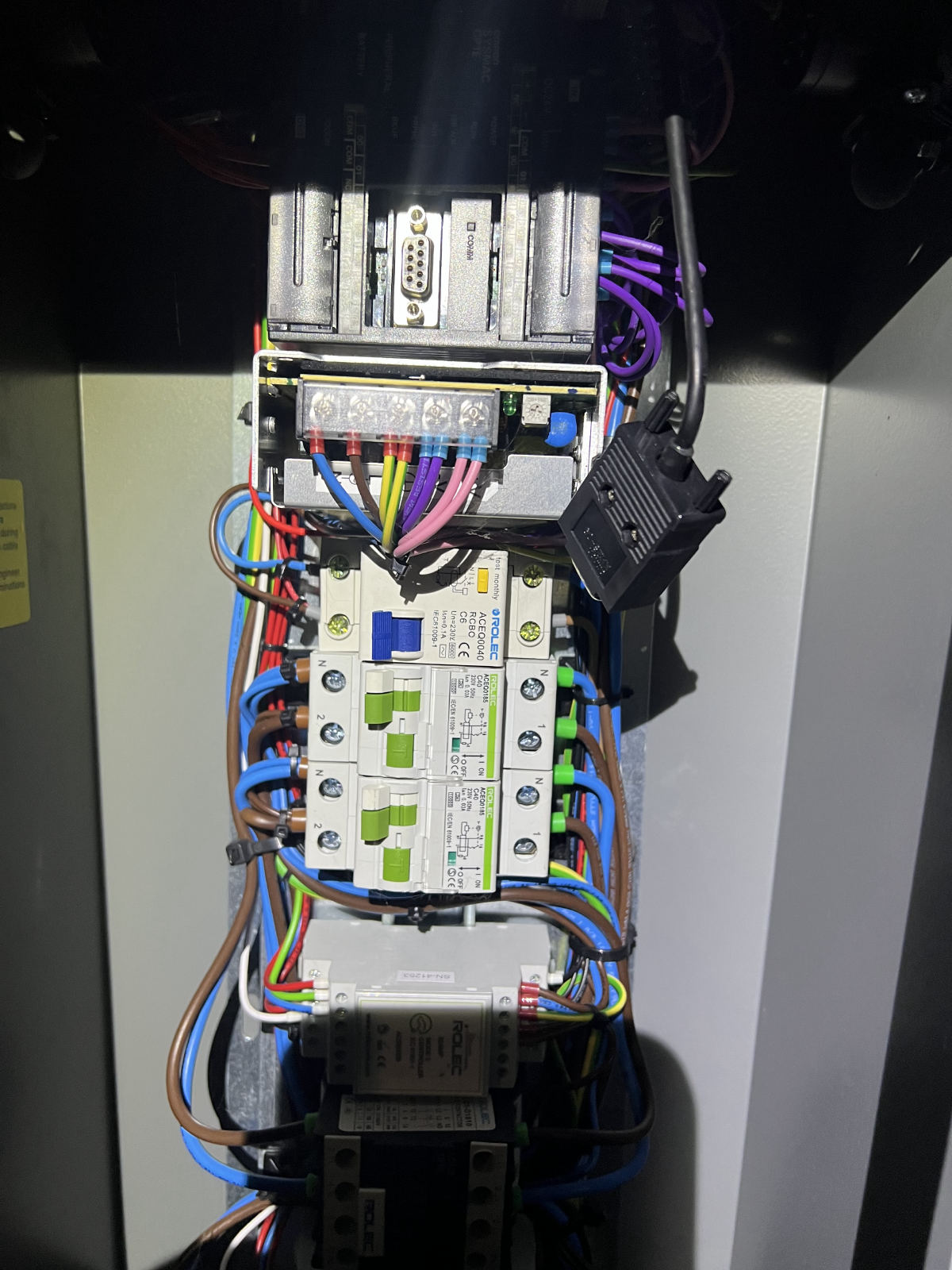
On the unit photographed above, from the left: an Omron SYSMAC CP1E programmable logic controller, a DIN-rail power supply, a 6 A RCBO for the control side, two 40 A RCBOs at 30 mA for the charging circuits, a Rolec Mode 3 controller module, and a contactor.
Two things about that layout matter a great deal to anyone deciding whether to repair or replace.
The brain is an off-the-shelf industrial PLC. The Omron is a standard part used across factories and machinery; it is not an EV-specific component and it is not scarce. What is Rolec's is the program inside it, and that is not something an owner or an independent can obtain, read or modify.
The power switching is on a separate contactor, not on a circuit board. That single design decision is why these units are so repairable: the part that carries the current and the part that does the thinking are different components, and either can be replaced without disturbing the other.
What we found on this one
The Mode 3 controller module failed — the component that handles the pilot signalling to the vehicle under IEC 61851-1, negotiates the available current and tells the contactor when to close. When that dies, the charge point is inert: it has power, it has protection, it has a perfectly good socket and cable, and it cannot start a session, because the conversation with the car never happens.
Everything else on that rail was healthy. The Omron, the RCBOs, the contactor, the supply, the enclosure, the cable, the pedestal in the ground.
What we did, and what stayed
We replaced the failed controller with our own control electronics and left the rest of the installation alone.
We design and manufacture our own charge point controllers, and ours is deliberately built without the power relay on the board — the switching stays on a separate contactor. That was a safety decision first: heavy current and arcing do not belong on a control board, and a welded contact should not be able to take the controller with it. The side effect is that the board is small, so it fits inside enclosures it was never designed for.
On a Rolec that fits particularly cleanly, because Rolec had already put the contactor on the rail. The swap was one component. What stayed:
- the protective devices — the RCD arrangement stays, because that is what an EV circuit is required to have and there is no reason to disturb it
- the existing contactor — we use theirs. Our controller does not carry the switching, so it does not need its own
- the enclosure and the pedestal, and the ground they are set into
- the buried supply cable and the civils — the genuinely expensive part of any installation
- the socket and the cable
What comes out is the manufacturer's own control layer. Whatever a given brand calls those modules varies from maker to maker and does not much matter once they are no longer in use — what matters is that the protection and the switching are sound, because those are the parts that stay.
The charge point comes back as a supported, current-generation unit, and we issue documentation and a warranty covering the electronics we have fitted and the work we have done. It is not somebody else's abandoned product any more.
Setting the current to the installation, not to the car
A modern car on a single phase will take about 7.5 kW if it is allowed to. Whether it should be allowed to is a question about the installation, not about the car.
So on commissioning we connect a display temporarily and set the charging current against what is actually there: the cross-section of the buried supply cable, and the rating of the contactor doing the switching. On an older pedestal — and many of these went in before anyone knew how charging would develop — those two numbers are frequently lower than a new installation would use, and the setting has to respect them.
They are also not the whole story, and we have learned that the hard way. There can be a protective device upstream that nobody has recorded and the owner cannot point to, quietly limiting the circuit to something well below what the cable would carry. If it exists, it will find you on about the second day of charging. Before an engineer sets your current, it is worth knowing where every device between the meter and the charge point is.
Why there is no screen on ours
Our controller can drive a display, and we used to fit one on the outside. We stopped after our first complaint about one, which was that the screen could not be seen — and the customer asked us to fit a bigger screen.
The complaint was right. The fix was not. A larger screen is a larger consumable: it fogs, it bleaches in sunlight, it gets broken, and it still cannot be read from a car in the rain. We had already seen what happens at the end of that road on other manufacturers' equipment — on a Delta DC unit we attended, the display had clouded so badly that a character was lost out of the fault code, which is enough to send an engineer to the wrong component.
So the display stopped being the owner's and became the engineer's. We plug one in during commissioning, set the current, and take it away with us. What stays on the unit is a status LED and a printed legend telling you what each colour means. It is readable at a distance, in weather, without walking up to it; there is no firmware behind it that can crash or display something untrue; and if the label ever fades it is a label, not a repair.
There is a second benefit on a site with more than one charge point. Mixed estates are normal — a car park picks up a Rolec, then something else two years later, then a third brand — and each one signals differently. Once they are re-equipped they all speak the same language: one colour means one thing across the whole site, one set of electronics to maintain, one number to call.
When we will tell you to replace it instead
Re-equipping is not always the right answer, and we would rather say so than take the work:
- The enclosure is cracked, corroded, or has been letting water in. That is a new unit.
- The supply is undersized or in poor condition — then the cable is the job, not the box.
- The unit is still under a warranty somebody will actually honour. Claim it.
- It is an early low-power model that no longer suits the car, and a replacement genuinely costs less.
And two things nobody can do, whatever they tell you: no independent can restore another company's cloud service, and no independent can write or sign firmware for somebody else's product. Re-equipping is not a way of reviving a dead service — it removes the dependence on one.
If yours has stopped
Send us the model, a photograph of the label, and one line on what it does — dead entirely, lights but no charge, starts then stops, or trips the protection. That is usually enough for us to say whether it is a part, a visit, or something the site can clear itself.
We repair charge points of any make, hold sockets, connectors, contactors and control components in stock, and where the station allows it we can agree a fixed all-in price before we start.
Send us a message about your charge point
Related: orphaned chargers and the 2G/3G switch-off · charge point repair service · EV charger maintenance · home EV charger repair