
Pod Point Not Working? Start With One Reset, and Read This Before You Replace It
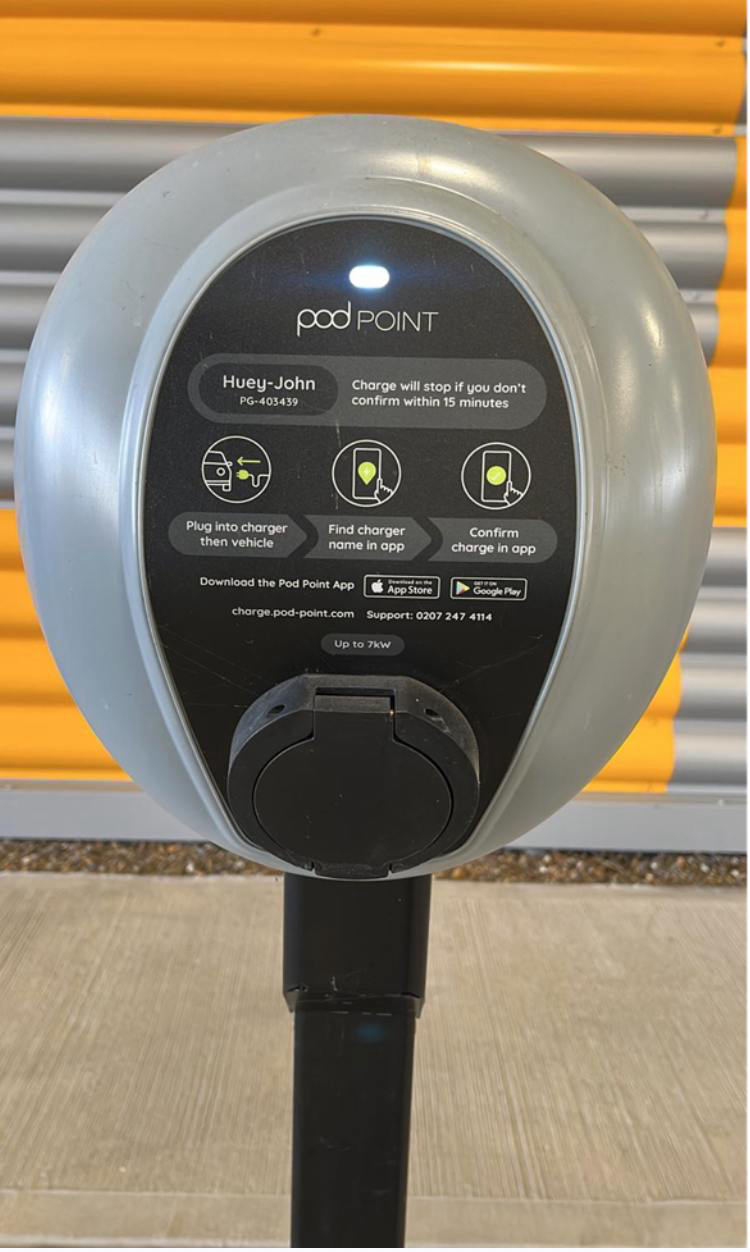
Pod Point put a very large number of charge points on British driveways and car parks, particularly between 2018 and 2021 when the home grant was at its most generous. A lot of those units are now six to eight years old, out of warranty, and starting to want attention.
This is what to do about that, in the order we would do it.
First: reset it once. It usually works
Whatever the light is doing — whatever colour, however many flashes — the first thing to try is a single power cycle.
Unplug the cable from the car. Switch the charge point off at its isolator or breaker. Leave it off for half a minute. Switch it back on.
In our experience roughly nine times out of ten that clears it, because the great majority of fault indications on a unit of this age are the controller having hung rather than anything being wrong with the hardware. It has cost you nothing and it has probably saved you a call-out.
We would rather tell you that than sell you a visit you did not need.
Then: what it means if it comes back
Counting the flashes only becomes worth doing after a reset has failed. If the same indication returns, something is actually being detected, and that is a different conversation.
Two things to establish before anybody attends, because they point in completely different directions:
- Did something in the consumer unit trip, or is the charge point itself showing a fault while its protection stayed on? A tripped RCD is a fault current being detected and must not be repeatedly reset — we have written up why a charger that keeps tripping should never be reset repeatedly, and separately the two completely different kinds of trip and how to tell them apart.
- Does it fail with nothing plugged in? If yes, the fault is in the unit or its supply, not the cable and not the car.
And photograph the light rather than describing it. “Flashing red, three times, then a pause, repeating” with a photograph attached is worth more than a paragraph, because colour conventions differ between makes and a description can be read two ways.
Where you actually stand on warranty
Pod Point is trading normally. It was taken private by EDF in August 2025 and now sits inside EDF's home energy business, and in May 2026 it acquired EO Charging out of administration — so if anything it is the company picking up other people's orphaned equipment rather than becoming orphaned itself.
One thing worth knowing when you go looking for support: the brand changed to “Pod” in May 2025, and pod-point.com now redirects to podenergy.com. If you searched for the company and ended up somewhere with a different name, that is why.
So this is not a story about being abandoned. It is a much more ordinary one: your unit is out of warranty, and you have to decide what to do with it.
The decision you are actually making
When an out-of-warranty charge point misbehaves, an owner is usually offered one option: a new charger. That is a real answer and sometimes the right one, but it is worth seeing what it costs you beyond the box.
A replacement means new fixings, a new cable route, possibly new consumer unit work, making good, and a day waiting in. The hardware is often the smaller half of it. And the expensive part of your original installation — the supply cable, the groundworks if it is a pedestal, the electrical work — is thrown away along with the perfectly good enclosure it was connected to.
What we do instead
We design and manufacture our own charge point control electronics, so where the enclosure and the supply are sound we replace the control layer and leave everything else where it is.
On a Pod Point this is about as clean as the job ever gets, and there are two reasons for that.
There is no display to deal with. A Pod Point signals with a light, and so does a unit we have re-equipped, so nothing changes about how you use it. On other makes we have to explain why the screen has gone. Here there is nothing to explain.
And there is room inside. The rounded enclosure has a lot of free space, and our board is small — we build it without the power relay, keeping the switching on a separate contactor, which was a safety decision first and has the side effect of fitting in places it was never designed for.
The whole job takes about ninety minutes. What stays: the enclosure, the mounting, the supply cable and any groundworks, the protective devices where they are correct for an EV circuit, and the socket or tethered cable. What you get back is a supported, current-generation unit with documentation and a warranty on the electronics we have fitted and the work we have done.
Why we do not spend an hour finding the exact failed component
On a unit of this age, tracing a fault to the individual part means hours of diagnosis followed by a hunt for a component that may not be made any more, fitted next to electronics that are the same age as the one that just failed.
Set that against ninety minutes and a year's warranty and the diagnosis becomes academic — whichever part had failed, the answer is the same. That is the arithmetic being honest, not a shortcut.
We work the other way on DC rapid units, where we repair rather than re-equip and the exact component is the whole job. There is a worked example of that here.
When we will tell you to replace it
- The enclosure is cracked, corroded or has been letting water in — and if it has, read what water does inside a charge point before you cover it with anything.
- The supply is undersized or in poor condition. Then the cable is the job, not the box.
- It is an early low-power unit that no longer suits the car you drive.
- It is still covered by something somebody will honour. Claim it first.
Before you contact anyone
Work through the ten checks — scheduling in the car or the tariff app accounts for a large share of “my charger has stopped” and costs nothing to rule out.
Then send us a photograph of the light, a photograph of the rating label, and one line on what it does: dead entirely, lights but no charge, starts and then stops, or trips the protection. That is usually enough for us to tell you whether it is a visit, a part, or something you can clear yourself.
We repair and re-equip charge points of any make, and hold sockets, connectors, contactors and control components in stock.
Send us a message about your charger
Related: why connector damage spreads · home EV charger repair · charge point repair service · EV charger maintenance